Not every cube gets built around power level. Some are built around a feeling — the creak of ice underfoot, the howl across a frozen tundra, the particular dread of drawing a land when you're one mana short in a Coldsnap draft. The Frost Cube is exactly that: a 577-card ice-themed environment pulling heavily from Kaldheim, with deliberate dips into Coldsnap and Ice Age for flavor and mechanical texture. It is currently a work in progress, but the skeleton already reveals a cube worth examining closely.
One of the cube's defining structural choices: you may only add Snow-Covered Wastes as basics after the draft. No regular basics. This pushes players toward the fixing on offer in the cube itself and makes every land slot a meaningful decision — a concept borrowed from desert cube design and applied to a snow context.
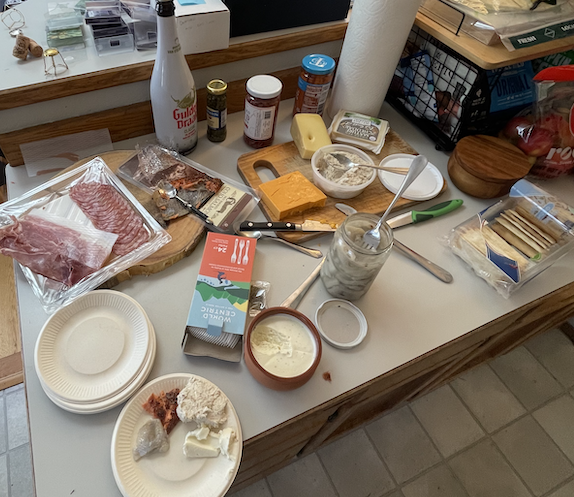
A playlist of Nordic and ice-themed songs curated to soundtrack the draft experience. Best enjoyed with the snacks.
The Ten Guilds of Ice
The cube is organized around ten two-color archetypes, each with a distinct identity. The breadth here is impressive — Kaldheim's mechanical vocabulary is rich enough to support fundamentally different strategies across all ten color pairs.
Archetype in Focus — Boros Equipment
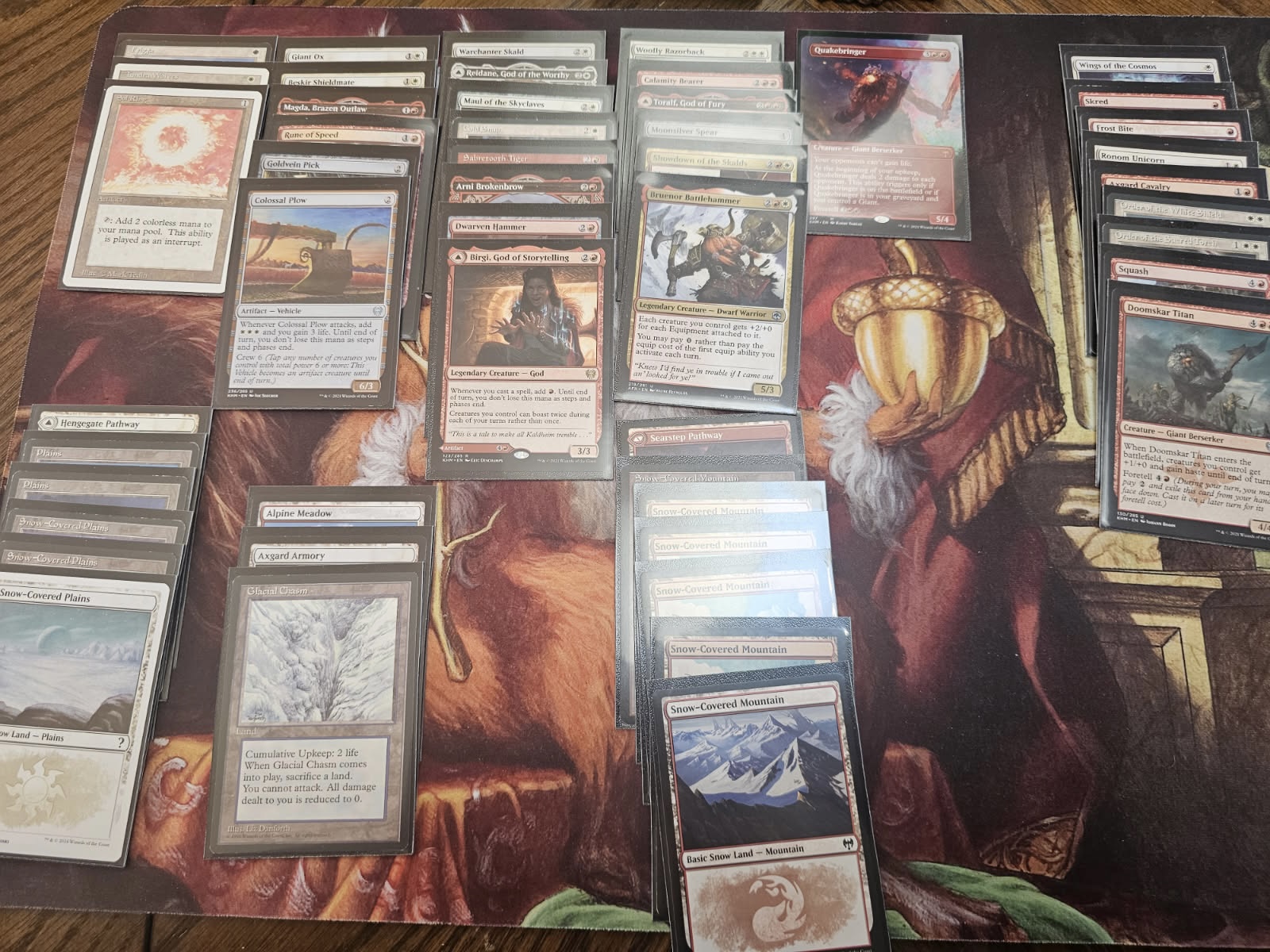
Of all the archetypes that materialized in the first drafts of this cube, none drew more concessions across the table than the Boros Equipment shell. On paper it reads as a straightforward Boast-and-attack strategy. In practice, two cards pushed it into a different category entirely: Sol Ring and Moonsilver Spear.
R W Creatures (14)
- 1Tundra Wolves
- 1Giant Ox
- 1Beskir Shieldmate
- 1Magda, Brazen Outlaw
- 1Warchanter Skald
- 1Reidane, God of the Worthy
- 1Sabretooth Tiger
- 1Arni Brokenbrow
- 1Birgi, God of Storytelling
- 1Woolly Razorback
- 1Calamity Bearer
- 1Toralf, God of Fury
- 1Bruenor Battlehammer
- 1Quakebringer
Spells (10)
- 1Fylgja
- 1Sol Ring
- 1Rune of Speed
- 1Goldvein Pick
- 1Colossal Plow
- 1Maul of the Skyclaves
- 1Cold Snap
- 1Dwarven Hammer
- 1Moonsilver Spear
- 1Showdown of the Skalds
Lands (16)
- 3Snow-Covered Plains
- 2Plains
- 1Hengengate Pathway
- 1Alpine Meadow
- 1Axgard Armory
- 1Glacial Chasm
- 6Snow-Covered Plains
- 1Searstep Pathway
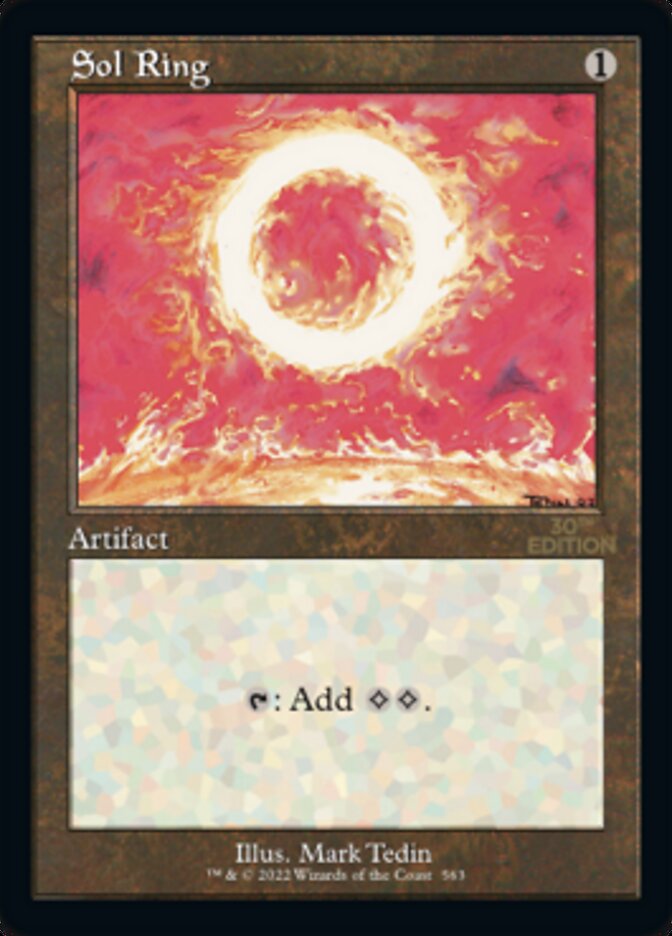
Sol Ring is a turn-one play that permanently warps the mana curve of any deck lucky enough to draft it. In an equipment shell, the implications are immediate: equipment cards carry steep equip costs, and Sol Ring effectively negates that tax on turn two. A Ring into a two-drop on turn one means the equipped creature can attack the very next turn, before most opponents have established any meaningful defense. The card was a first-pick-level bomb every time it surfaced in this pod.
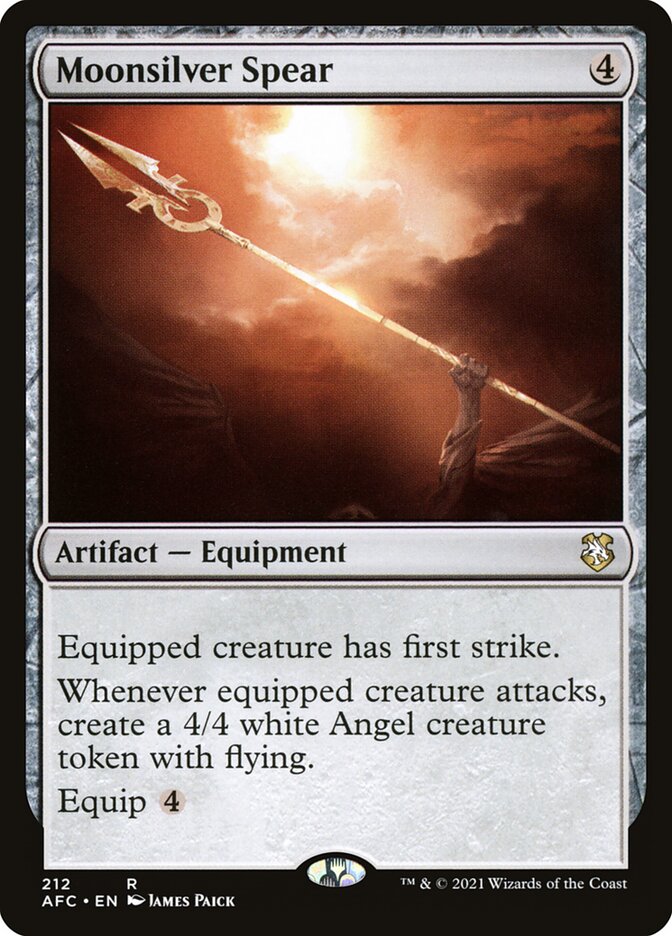
Eight mana to cast and equip is a real investment. But Moonsilver Spear doesn't need to be fast — it needs to resolve once. A single attack with the Spear equipped generates a 4/4 flying token alongside a first-striking threat, which in most board states means two bodies that need to be answered simultaneously. Opponents who tap out to develop their board run into a Spear swing and find themselves immediately behind on the air. Sol Ring made the Spear land a full turn earlier than any opponent could anticipate.
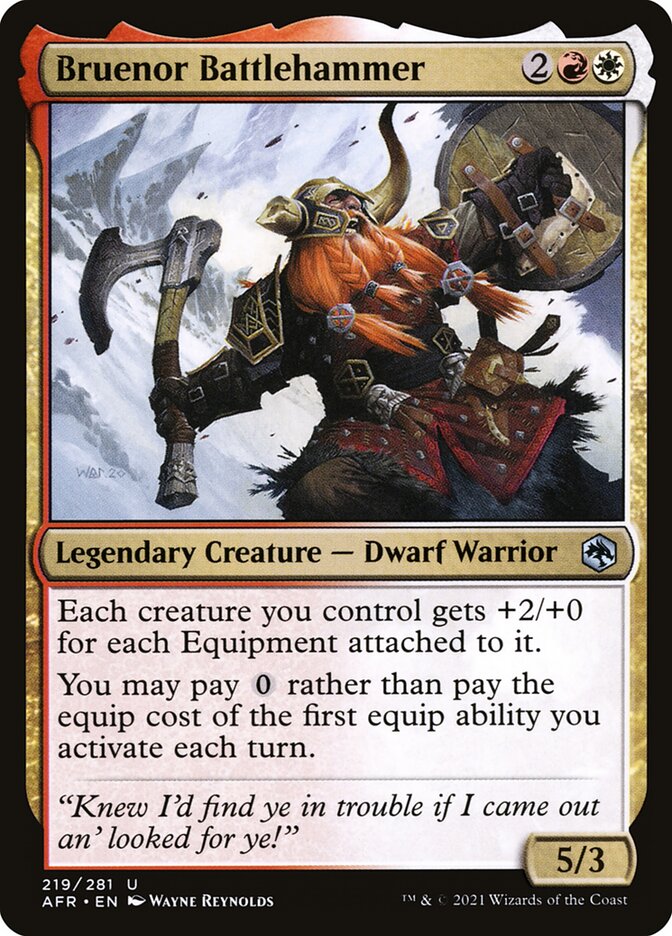
Bruenor is the engine that makes the archetype click. A free equip activation each turn removes the main friction of equipment-based strategies: you're no longer spending four or five mana a turn just to move a piece. Meanwhile the +2/+0 bonus per equipment turns even a modest two-equipment creature into a serious threat. Bruenor swinging with Moonsilver Spear attached is a 7/3 first striker that creates a 4/4 flier on attack — and the equip cost to move the Spear to him was zero. The combination with Sol Ring meant this board state could arrive as early as turn four.
Bruenor's free equip applies once per turn. Sol Ring's extra mana covers Moonsilver Spear's four-mana cast cost, getting the full package online a full turn ahead of schedule. This line ends games by turn five in a cube environment with no two-mana counterspells.
Card Spotlight — The Yeti of Ice Age
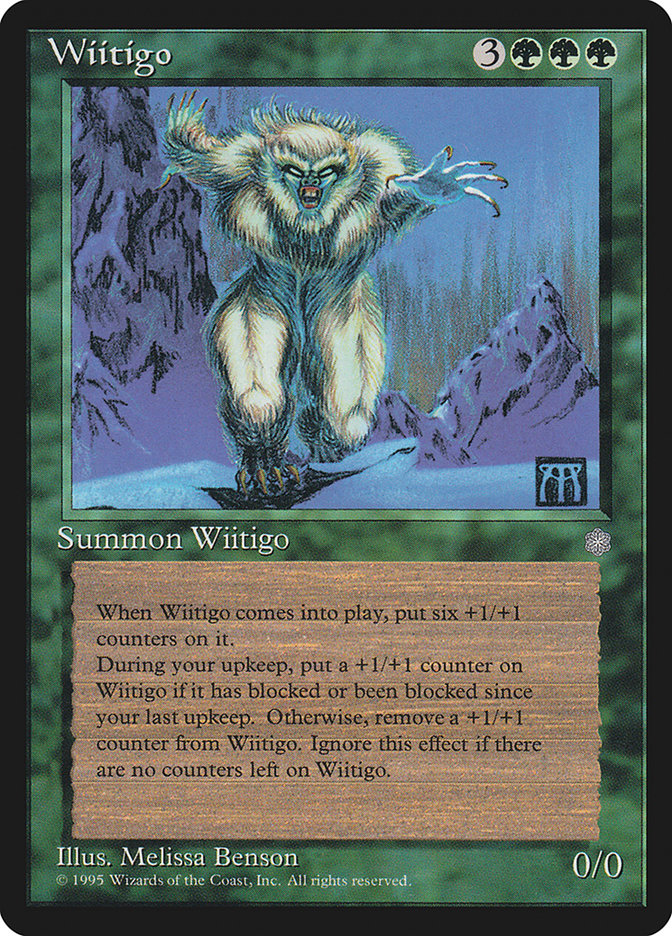
On its face, Wiitigo is a six-mana 6/6 that requires you to be in combat every turn to maintain its size. In an aggressive green deck that's attacking or trading every turn, that condition is trivially met. In a more controlling shell it becomes a clock that drains itself. Draft context matters enormously here.
Card Spotlight — The Monstrous Raider
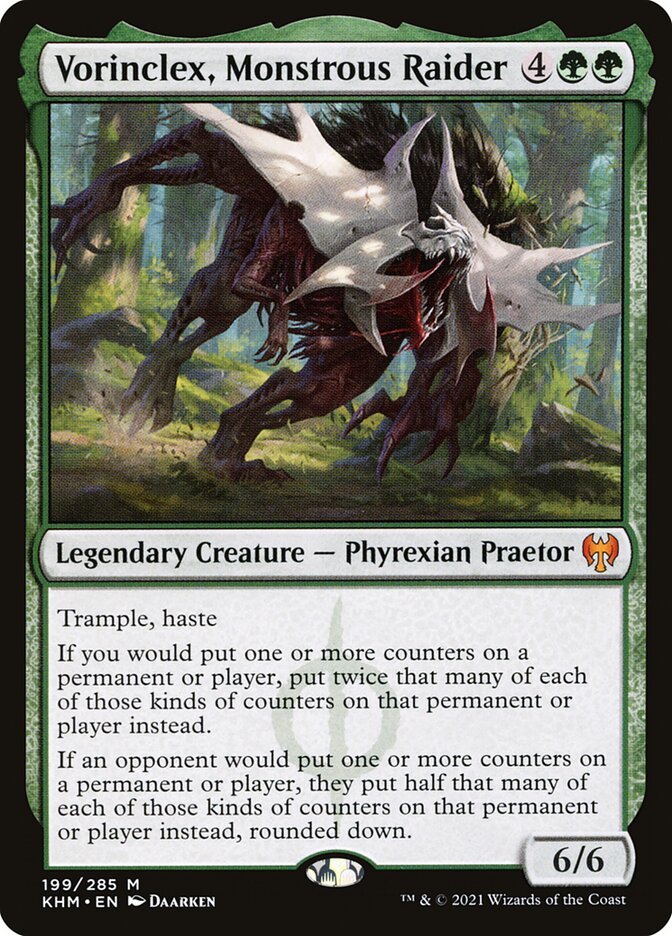
Vorinclex demands an immediate answer in any game state. A 6/6 with trample and haste is already a closing threat on its own merits. The counter-doubling ability is the text that makes other decks in the cube take notice — and the text that makes the following interaction so devastating.
The Interaction — Wiitigo Enters the Battlefield
The most talked-about line in this cube involves these two cards sharing the battlefield at the same time. Wiitigo's counter placement happens as it enters the battlefield — a replacement effect applied during the resolution of the enter-the-battlefield event. Vorinclex's doubling ability is a replacement effect that modifies how many counters are placed on permanents you control.
Because both effects apply at the same time, the interaction resolves cleanly: Vorinclex sees that Wiitigo would enter with six counters and replaces that with twice as many. The Yeti that normally shambles in as a 6/6 instead arrives as a 12/12.
Vorinclex's ability is a replacement effect, not a triggered ability. It intercepts the counter placement before it happens rather than responding after the fact. This means it applies to enter-the-battlefield counters — including Wiitigo's six — as part of the same continuous event.
But the interaction doesn't stop at entering the battlefield. Wiitigo's upkeep trigger also feeds through Vorinclex's doubler. Each turn that Wiitigo blocks or is blocked, it would gain one counter — instead it gains two. And each turn it fails to see combat, it loses one counter — not two, because Vorinclex's halving clause only applies to opponents' counter placement. Your Wiitigo can only grow.
Both Wiitigo and Vorinclex fall squarely in the Gruul (Green-Red) archetype — trolls and ramp. Wiitigo is a throwback Ice Age inclusion that fits the cube's flavor mandate; Vorinclex is the bomb rare from Kaldheim that defines the top end of the green curve. When you ramp into Vorinclex on turn four and untap with a Wiitigo in hand, the game state becomes very difficult to answer.
Card Spotlight — Marit Lage's Slumber
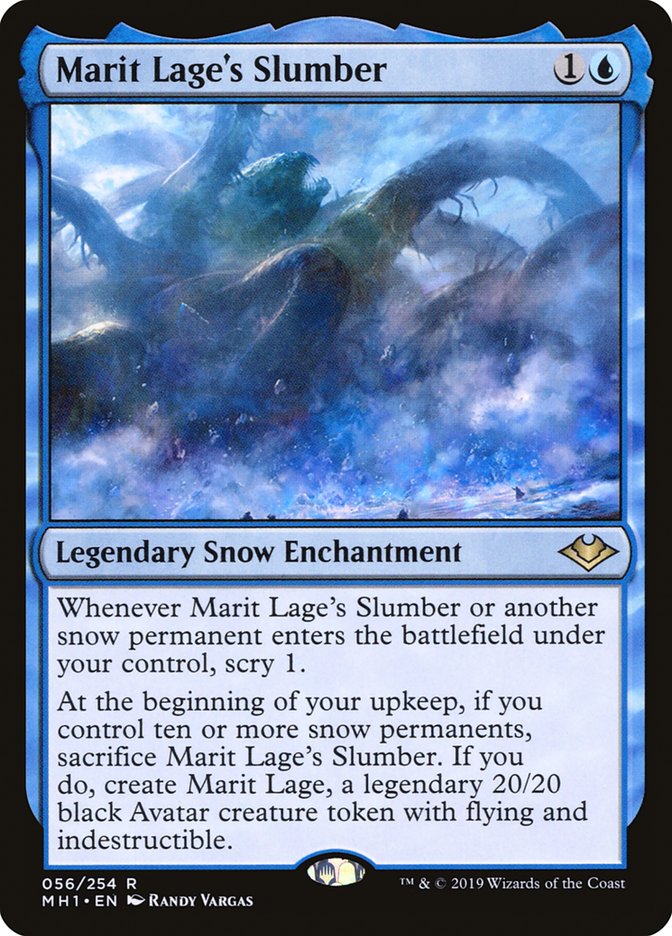
In a normal environment, counting to ten snow permanents is a restrictive ask. In the Frost Cube, it's a design goal. The snow-basics-only rule means every land you add to your deck after the draft is a snow permanent. Draft a deck that naturally plays ten to twelve snow lands, and Marit Lage's Slumber becomes a two-mana win condition that your opponent cannot interact with on the stack.
The Slumber rewards a specific style of play that this cube enables almost accidentally. Because the snow dual lands are all typed basic land subtypes (Mountain Plains, Island Swamp, and so on), every dual in your mana base counts toward the ten-permanent threshold. A two-color deck running eight snow duals plus two snow basics already has the Slumber active by the time it lands on an empty board. That's before any other snow permanents — creatures, artifacts, or enchantments — push the count higher.
The Slumber also scries 1 on each entering snow permanent, meaning your draw step is consistently sculpted throughout the game while you wait to hit ten. This incidental advantage makes it worth including even in games where the Marit Lage token never resolves.
Marit Lage's Slumber lands cleanly in the Dimir snow/zombie archetype — a two-mana blue enchantment that pays off as games go long. The Dimir player who also controls a handful of snow creatures (zombies count) can hit the ten-permanent threshold well before turn ten, turning the Slumber from a late-game threat into a mid-game inevitability.
Blue's Defensive Toolkit — Tappers & Glacial Slowness
One of the more interesting subthemes the cube surfaces is a suite of old-school blue control pieces that reward patience and positional play. The cube includes several cards from Ice Age and Kaldheim whose job is simply to slow the game down — freezing creatures, locking attackers, and buying the turns needed to assemble a win condition. Not all of them performed equally.
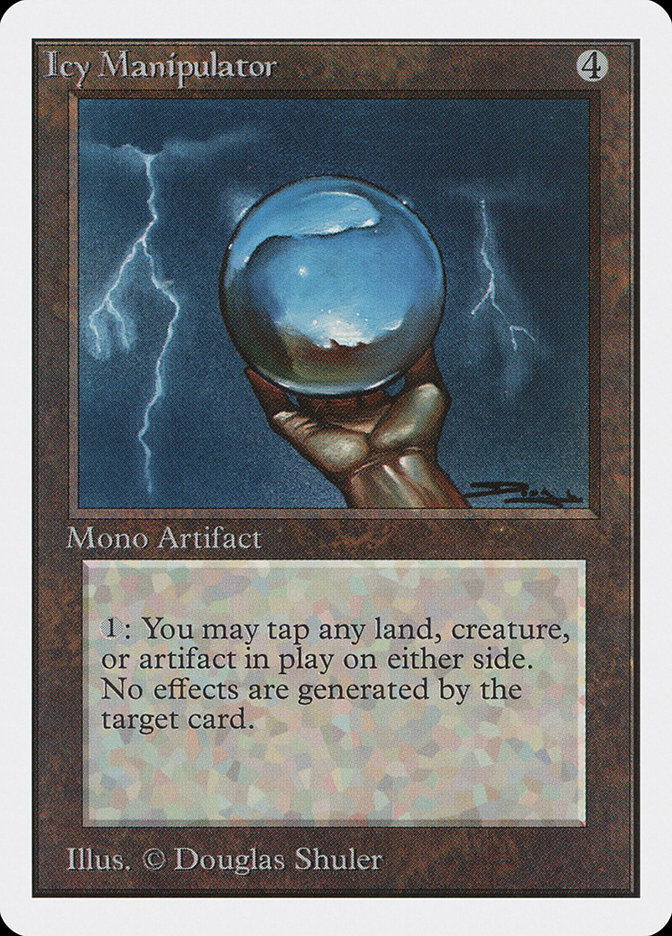
The original tapper, and a card with a storied history. In this format, however, Icy Manipulator proved too slow. A four-mana artifact that costs an additional mana and a tap to activate is asking a lot in a format where the Boros Equipment deck is going wide and fast by turn three. By the time the Manipulator came online, the damage had often already been done. It remains a powerful card — versatile enough to tap lands or artifacts, not just creatures — but the tempo cost was too steep in most matchups.
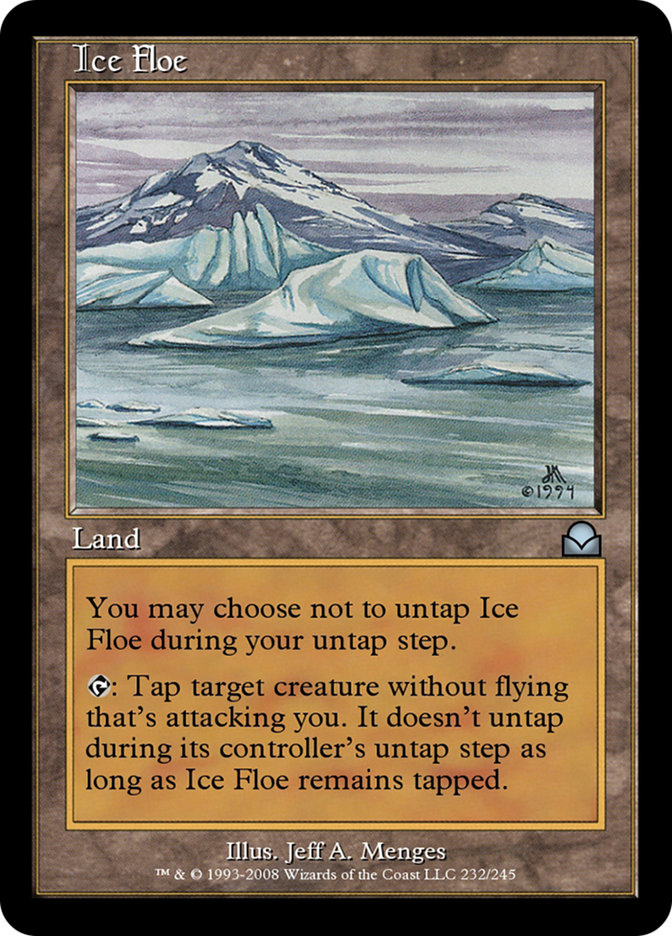
Ice Floe was the surprise standout. A land that costs no mana to use — just a sacrifice of its own untap — Ice Floe can freeze an attacking threat for multiple turns simply by staying tapped. Against a ground-based aggro deck like Boros Equipment, this effectively removes their most dangerous attacker from combat indefinitely. The "without flying" restriction matters less in a ground-focused format, and the zero mana cost means it fits into any mana base without any deckbuilding concession.
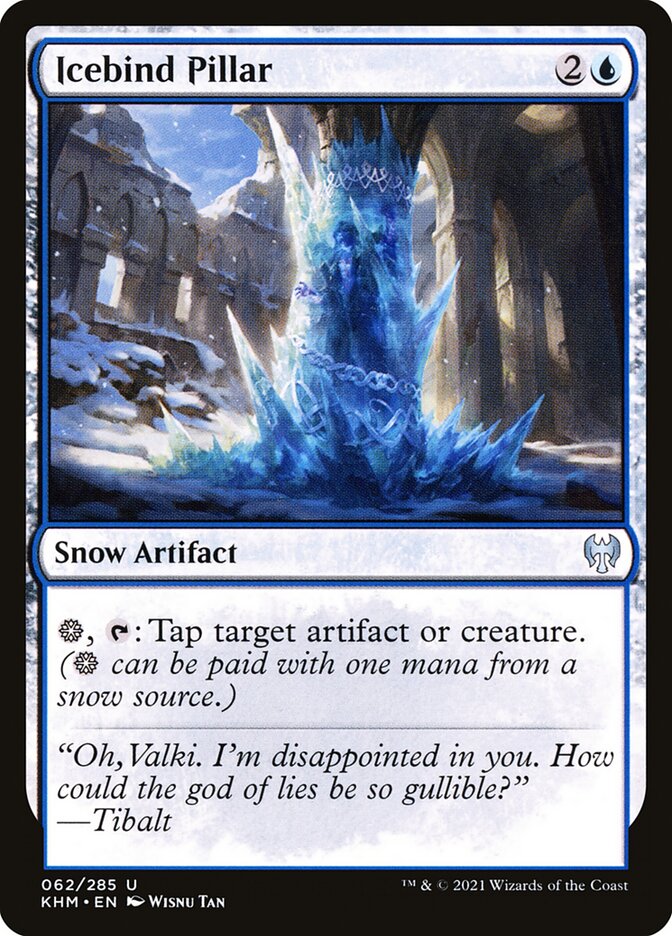
Icebind Pillar is the Kaldheim answer to Icy Manipulator — cheaper to cast at three mana, and requiring only one snow mana to activate rather than a colorless plus a tap. In a cube built around snow permanents, finding a snow source to pay {S} is trivially easy by turn three. The pillar also counts as a snow permanent itself, nudging the Marit Lage's Slumber count upward. It proved far more effective than its vintage counterpart at disrupting early aggro — landing a full turn sooner and costing less per use.
Glacial Slowness
Beyond the active tappers, the cube includes two Ice Age cards that represent a different flavor of defensive blue: walls and catastrophic land effects that prioritize survival over tempo.
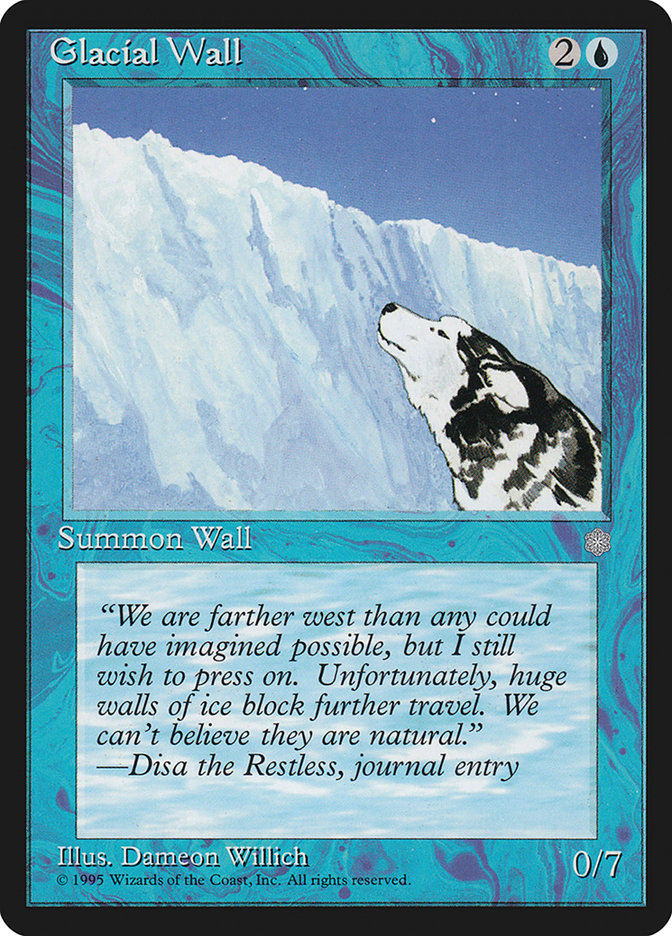
A 0/7 for three mana that cannot attack. Glacial Wall sits in front of almost every ground-based threat the aggro decks can produce. The Wall is almost never a good topdeck in the late game, but drafted early it acts as a hard wall against the format's most aggressive curves. Flavor-perfect for the cube's aesthetic, and mechanically, genuinely useful.
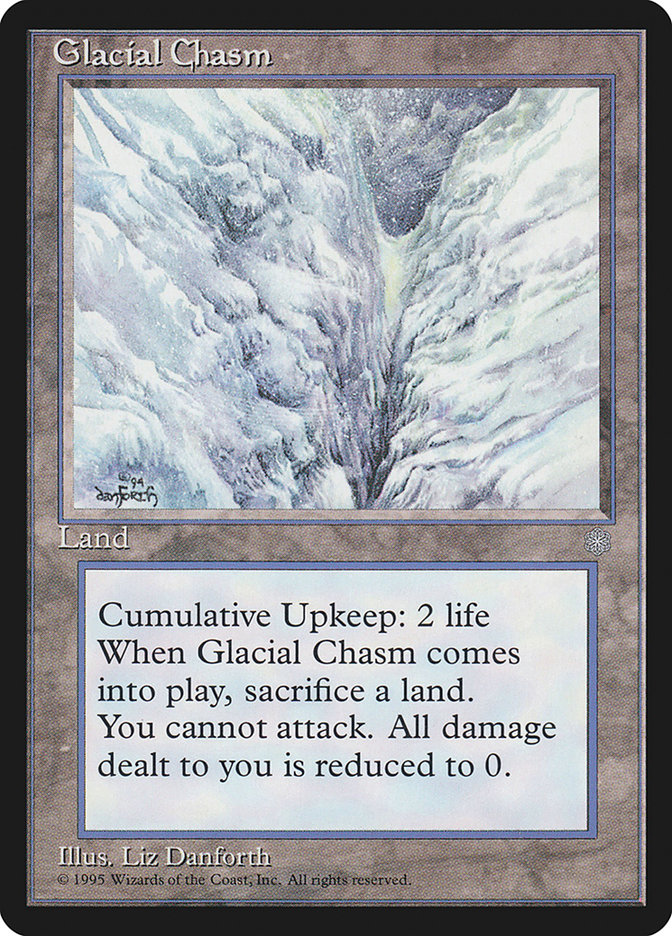
Glacial Chasm is a panic button that doubles as a win condition enabler. Entering into play costs a land sacrifice and locks out your own attacks — a steep price. But in a game where you're assembling Marit Lage's Slumber and need three more turns to hit ten snow permanents, Glacial Chasm buys exactly that. The cumulative life cost escalates quickly, so it can't be held indefinitely, but used at the right moment it is essentially a "you cannot kill me this turn" spell stapled to a land. Against the Boros player who is about to end the game with a Spear swing, that's exactly what you need.
Ice Floe — Best in class. Zero mana, locks ground attackers indefinitely.
Icebind Pillar — Strong. Snow cost trivial in this cube; also a snow permanent.
Icy Manipulator — Situational. Too slow for the aggressive early turns, but uniquely versatile (taps lands and artifacts).
Glacial Chasm — High risk, high reward panic button. Synergizes specifically with Marit Lage's Slumber.
The Mana Base — Kaldheim Snow Duals
One of the Frost Cube's most elegant structural decisions is its fixing package. Kaldheim shipped with a complete cycle of ten snow dual lands — one for each two-color pair — each typed as a Snow Land with two basic land subtypes. They enter tapped, which is the expected cost for fixing in a draft environment, but they count as two land types, produce snow mana, and work with any basic-land-matters effect in the cube.
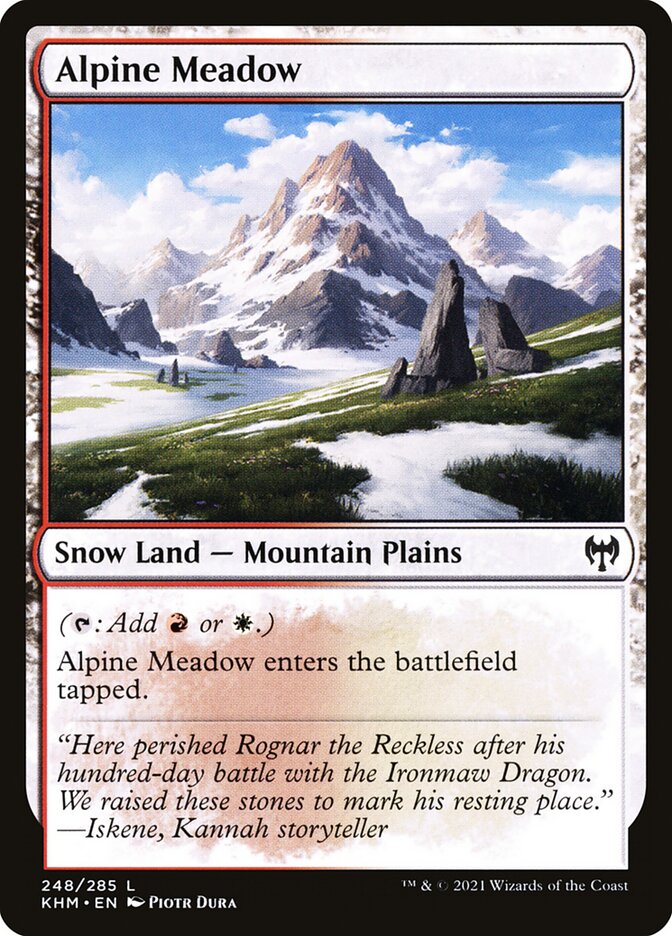
The Boros fixing land. Every Boros Equipment drafter wants this in the early picks — it fixes both colors, counts as a snow permanent, and interacts with any Mountain or Plains synergy in the cube. The tapped entry is the only real cost, and in a midrange-skewing environment that cost rarely matters past turn three.
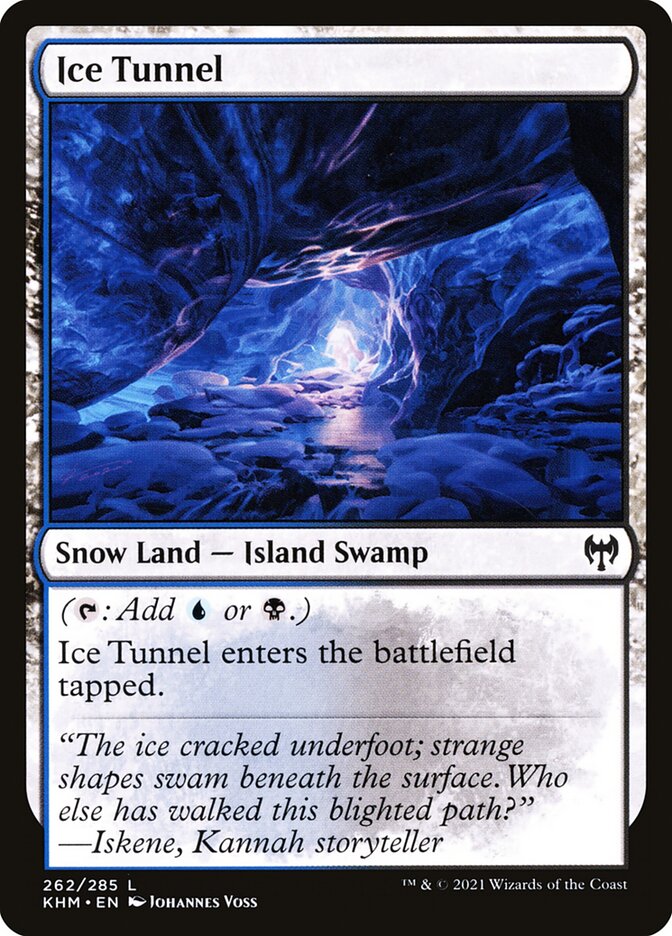
The Dimir fixing land — and critical for the Marit Lage's Slumber build. Ice Tunnel contributes to the ten-snow-permanent threshold while simultaneously fixing both colors, meaning it does double duty as fixing and combo enabler. Drafting multiples is correct in any Dimir build going deep on the snow plan.
The full Kaldheim snow dual cycle covers all ten guild pairs. Each land is a Snow Land with two basic subtypes, enters tapped, and taps for either of its two colors. Because the cube restricts basics to Snow-Covered Wastes only, these duals become the primary mana fixing available — making them substantially higher picks here than they would be in a typical draft. A player who secures three or four copies of their guild's dual in pack one is in excellent shape; a player who misses them often finds the mana base painful to operate.
* W/U Glacial Floodplain · W/B Snowfield Sinkhole · W/R Alpine Meadow · W/G Shimmerdrift Vale · U/B Ice Tunnel · U/R Volatile Fjord · U/G Rimewood Falls · B/R Sulfurous Mire · B/G Woodland Chasm · R/G Highland Forest
Decks from the Table
Below are photographs of the actual decks that came out of the first Frost Cube session. Each build tells a different story about how the cube's archetypes play out in practice.
U W White-Blue Flyers & Evasion — Foretell and aerial pressure
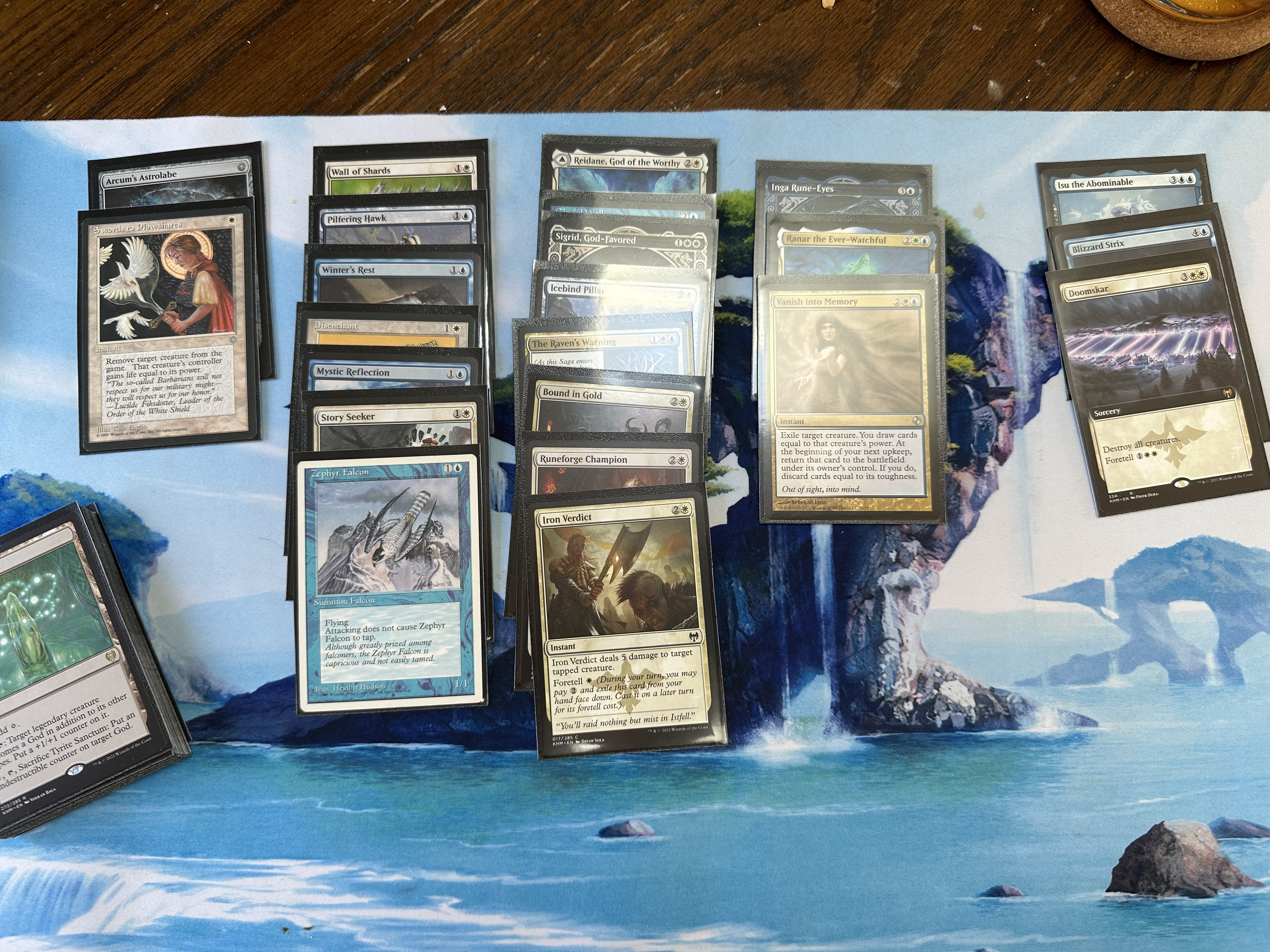
U W Creatures (12)
- 1Wall of Shards
- 1Pilfering Hawk
- 1Story Seeker
- 1Zephyr Falcon
- 1Reidane, God of the Worthy
- 1Glacial Wall
- 1Sigrid, God-Favored
- 1Runeforge Champion
- 1Inga Rune-Eyes
- 1Ranar the Ever-Watchful
- 1Isu the Abominable
- 1Blizzard Strix
Spells (9)
- 1Arcum's Astrolabe
- 1Sword to Plowshares
- 1Winter's Rest
- 1Disenchant
- 1Mystic Reflection
- 1Icebind Pillar
- 1The Raven's Warning
- 1Bound in Gold
- 1Iron Verdict
- 1Vanish into Memory
- 1Doomskar
Lands (17)
- 1Ice Floe
- 1Glacial Floodplain
- 1Tyrite Sanctum
- 7Snow-covered Island
- 7Snow-covered plains
R G U RGU Aggro & +1/+1 counters
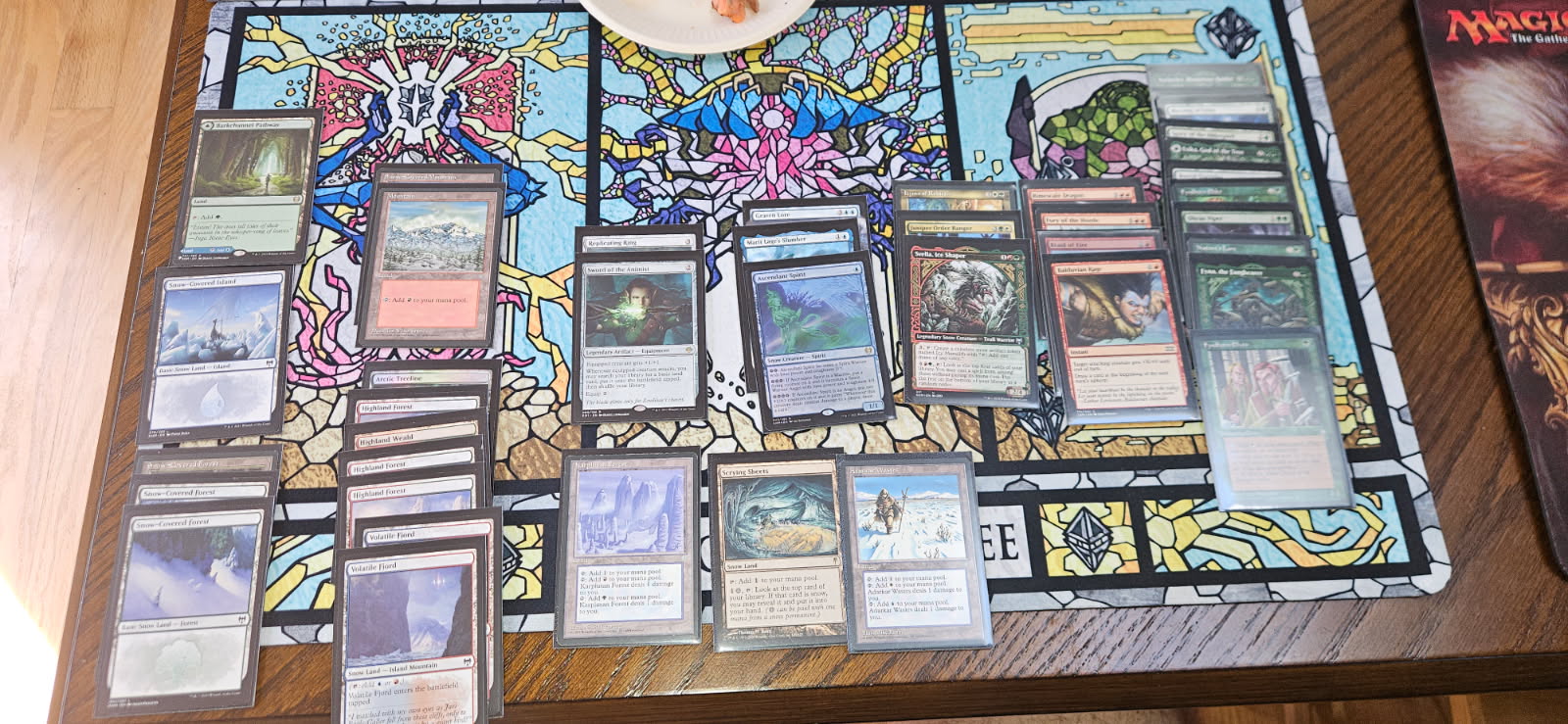
R G U W Creatures (12)
- 1Juniper Order Ranger
- 1Svella, Ice Shaper
- 1Rimescale Dragon
- 1Fyndhorn Elves
- 1Fynn, the Fangbearer
- 1Fyndhorn Elder
- 1Esika, God of the Tree
- 1Vorinclex, Monstrous Raider
- 1Wiitigo
- 1Ohran Viper
- 1Spirit of the Aldergard
- 1Icehide Troll
Spells (9)
- 1Replicating Ring
- 1Sword of the Animist
- 1Graven Lore
- 1Marit Lage's Slumber
- 1Hymn of Rebirth
- 1Fury of the Horde
- 1Braid of Fire
- 1Bound in Gold
- 1Balduvian Rage
- 1Nature's Lore
- 1Blizzard Brawl
Lands (17)
- 3Snow-Covered Forest
- 1Snow-Covered Island
- 1Barkchannel Pathway
- 1Snow-Covered Mountain
- 1Mountain
- 1Karplusian Forest
- 1Arctic Treeline
- 3Highland Forest
- 2Volatile Fjord
- 1Scrying Sheets
- 1Adarkar Wastes
U B G UBG Monsters — Ambition Outpacing the Mana
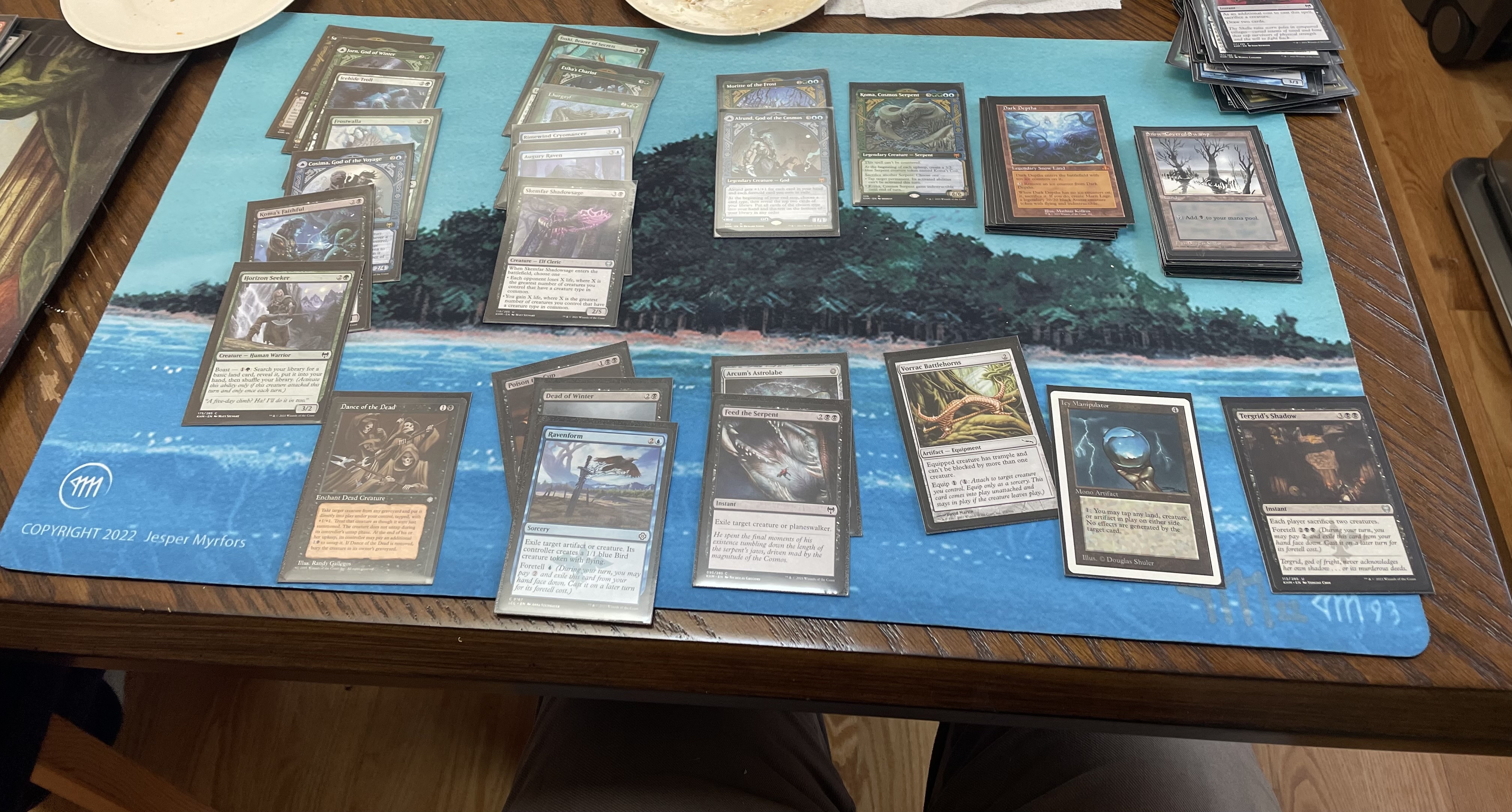
The UBG Monsters deck was the most ambitious build of the session. The drafter assembled an impressive collection of high-cost threats across three colors, supplemented by a light recursion subtheme — several cards that could pull creatures back from the graveyard or generate repeated value from the bin. On paper it looked like the kind of late-game inevitability that should dominate a slower pod.
In practice, the three-color mana base created too many awkward opening hands, and the absence of dedicated ramp meant the top-end monsters were consistently arriving one or two turns later than the game allowed. The Boros Equipment deck had already attacked twice with Moonsilver Spear by the time the first big threat resolved. The recursion subtheme provided genuine value in games that went long — pulling back a threat the opponent had just dealt with felt strong — but those long games were hard to reach when the early turns were spent on tapped snow duals.
Three-color decks in this cube need to prioritize the snow duals heavily in pack one. The monsters are there; the mana to cast them on curve is the scarce resource. A UBG build that drafts fixing in picks two through six and then fills threats in packs two and three is a different — and likely stronger — deck than one assembled the other way around.
U B G Creatures (16)
- 1Sarulf, Realm Eater
- 1Jorn, God of Winter
- 1Icehide Troll
- 1Frostwalla
- 1Cosima, God of the Voyage
- 1Koma's Faithful
- 1Horizon Seeker
- 1Toski, Bearer of Secrets
- 1Esika's Chariot
- 1Lhurgoyf
- 1Rimewind Cryomancer
- 1Augury Raven
- 1Skemfar Shadowsage
- 1Moritte of the Frost
- 1Alrund, God of the Cosmos
- 1Koma, Cosmos Serpent
Spells (9)
- 1Dance of the Dead
- 1Poison the cup
- 1Dead of Winter
- 1Ravenform
- 1Arcum's Astrolabe
- 1Feed the Serpent
- 1Vorrac Battlehorns
- 1Icy Manipulator
- 1Tergrid's Shadow
Lands (16)
- 1Dark Depths
- 4Snow-Covered Swamp
- 1Swamp
- 3Snow-Covered Island
- 2Island
- 4Snow-Covered Forest
- 1Forest
U B UB Zombies — Snow and the Undead
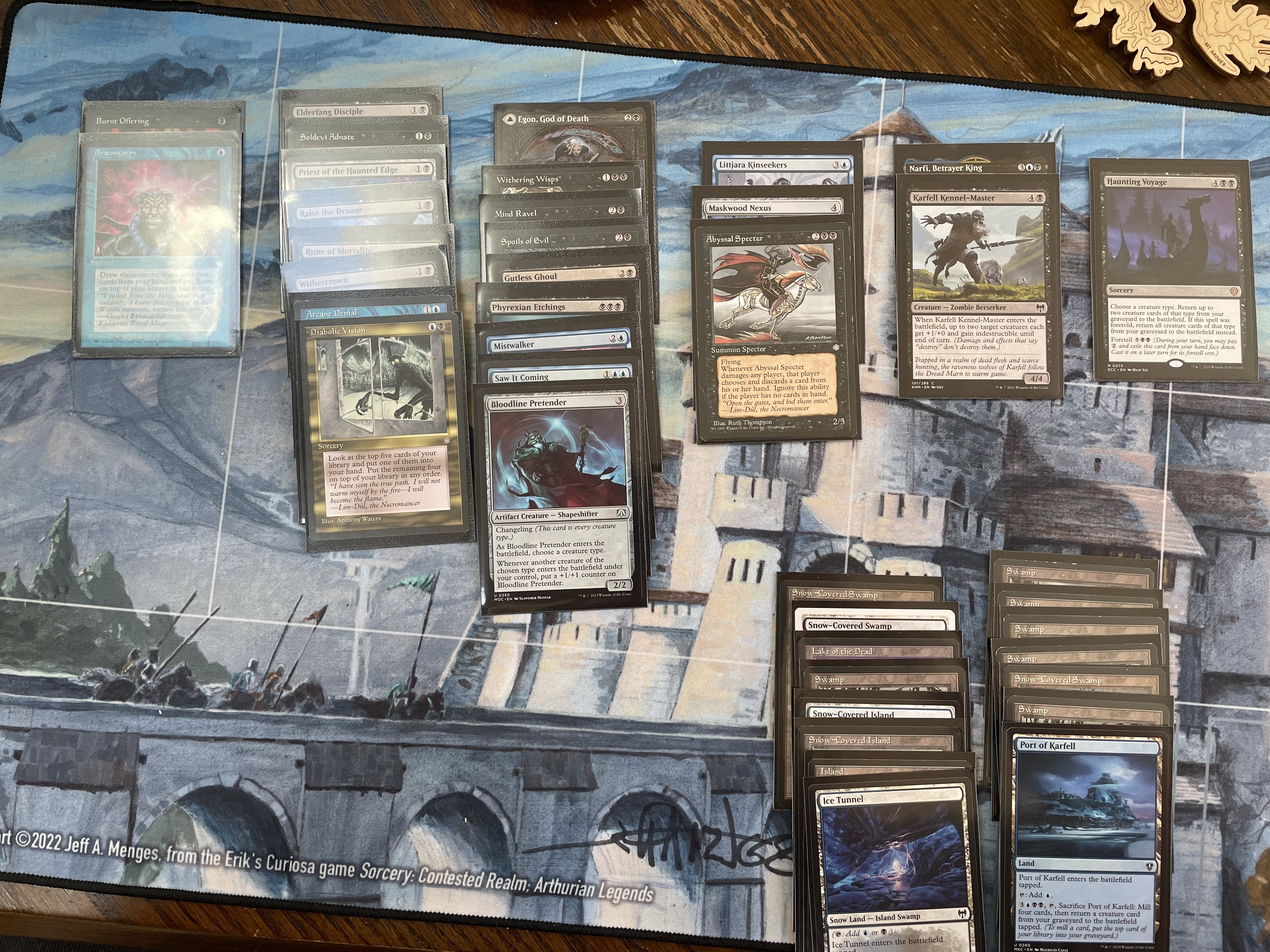
The Dimir Zombies deck was exactly what the archetype description promises: snow, self-mill, and an army of the undead. The snow synergies ran cleanly through a mana base of Ice Tunnels and snow basics, keeping the Marit Lage's Slumber threshold comfortably in reach. Zombie tribal gave the deck a resilient combat presence — creatures that return from the graveyard or generate additional bodies on death are particularly punishing in a format without abundant sweepers.
U B Creatures (11)
- 1Elderfang Disciple
- 1Soldevi Adnate
- 1Priest of the Haunted Edge
- 1Egon, God of Death
- 1Gutless Ghoul
- 1Mistwalker
- 1Bloodline Pretender
- 1Littjara Kinseekers
- 1Abyssal Specter
- 1Narfi, Betrayer King
- 1Karfell Kennel-Master
Spells (14)
- 1Burnt Offering
- 1Brainstorm
- 1Raise the Draugr
- 1Rune of Mortality
- 1Withercrown
- 1Arcane Denial
- 1Diabolic Vision
- 1Withering Wisps
- 1Mind Ravel
- 1Spoils of Evil
- 1Phyrexian Etchings
- 1Saw It Coming
- 1Maskwood Nexus
- 1Hauntng Voyage
Lands (15)
- 3Snow-Covered Swamp
- 6Swamp
- 1Lake of the Dead
- 2Snow-covered Island
- 1Island
- 1Ice Tunnel
- 1Port of Karfell
What Makes This Cube Worth Drafting
The Frost Cube's most interesting design tension is the one between the snow basic restriction and the breadth of the archetype map. Being locked into Snow-Covered lands rewards players who stay two colors and draft their fixing intentionally, but the ten archetypes span every possible pair. This creates genuine draft decisions at every pick — do you take the powerful off-color card knowing your mana might not support it, or do you stay disciplined and trust that your archetype's payoffs will come?
Kaldheim as a base set is well-suited for cube construction. Foretell gives you a built-in resource-management mechanic that rewards slower decks without feeling parasitic. Boast rewards the Boros aggro deck for attacking, which it was already doing. The Giants and Wizards of Izzet give tribal critical mass to a color pair that usually gets spell-based synergies instead.
The Coldsnap and Ice Age inclusions — Wiitigo chief among them — add character that Kaldheim alone couldn't provide. These cards have rougher edges, less templating polish, and a different power curve, which makes them genuinely interesting in a drafting context. A Wiitigo is not the same kind of threat as a clean Kaldheim rare, and that asymmetry rewards players who understand the older cards.
As the cube continues development, the Dimir snow/zombie archetype is the one I'd watch most closely. Snow matters cards tend to reward density; in a six- or eight-player draft, the snow basics will be contested. The archetype could be excellent in the right seat or stranded without it. That tension is exactly what makes a cube interesting to play repeatedly.